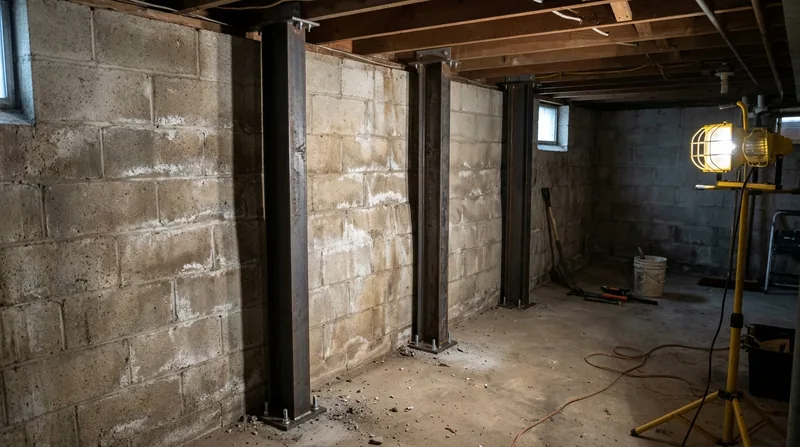




Iowa City sits in the Iowa River valley below Coralville Lake, where loess and glacial till clay on the uplands and limestone bedrock along the bluffs create real lateral pressure against basement walls. On the Northside and College Hill, 1850s to 1910s Italianate, Queen Anne, and Greek Revival homes rest on local limestone and brick foundations that were never engineered for today's saturated clay. In Goosetown, the small brick and frame Bohemian cottages from the 1870s to 1910s show the same pattern: block or brick walls pushed inward by hydrostatic pressure after heavy spring rain and hard freeze-thaw cycles. If a wall in your basement is leaning, bulging, or showing a horizontal crack near mid-height, you are looking at Bowing Wall Repair in Iowa City territory, and the sooner it is assessed, the more options stay on the table. We stabilize bowing walls with carbon fiber straps, steel I-beams, or wall anchors, matched to how far the wall has moved and what your soil is doing. Start with a free basement inspection so we can measure the movement instead of guessing at it.
Why Bowing Walls Show Up So Often in Iowa City's Older Basements
The dominant failure mode here is not a single event. It is years of clay soil swelling against a block or brick wall every spring, then frost driving deeper in January and February, then the wall relaxing slightly in summer without ever going back to where it started. Iowa City's 1910s to 1940s bungalows and foursquares in Longfellow and the ranches and split-levels on block basements across the east side and Coralville were built with walls that have little tensile strength. Once the mortar joints open and the wall starts to rotate, it does not self-correct.
- Horizontal cracking near the middle of the wall usually means soil pressure is pushing the center inward while the top and bottom stay put.
- Stair-step cracking through mortar joints on block walls follows the path of least resistance and signals movement, not just shrinkage.
- White efflorescence or a chalky bloom on the wall tells you water is moving through the masonry and depositing salts as it dries.
- Doors and windows that stick on the main floor above a bowing wall are a sign the movement has reached the framing.
- A wall that is visibly out of plumb by more than an inch over its height needs measurement, not a cosmetic patch.
Any one of these is worth a look, and two or more together mean the wall should be stabilized before the next spring thaw.
Key info: A 1920s foursquare in Longfellow with a block wall leaning about 1.5 inches at mid-height is a classic Iowa City case. The clay on that lot holds water after every big rain, and the wall has been creeping for a decade. Carbon fiber straps on the interior face usually stop that movement without excavation.
The City of Iowa City's building division handles permits for structural foundation work, and the rules are worth confirming before any repair begins: icgov.org is the place to start.
How We Diagnose and Stabilize a Bowing Wall in Iowa City
We do not sell a repair before we know what is moving the wall. The first visit is about measuring: plumb readings at several points, crack mapping, and a look at grading, downspout discharge, and the drain tile situation around the foundation. If the wall is bowing because water is loading the soil behind it, stabilizing the wall without addressing the water is a short-term fix. That is why the assessment covers both the structure and the foundation waterproofing picture at the same time.
- We measure the wall's out-of-plumb movement and record crack widths so we have a baseline to compare against later.
- We check the soil side by looking at grading, downspout extensions, and any evidence of hydrostatic pressure at the base of the wall.
- We match the method to the severity: carbon fiber straps for moderate movement, steel I-beams for heavier loads, wall anchors when the wall needs to be pulled back rather than just held.
- We install the system, torque or bond it per the manufacturer's spec, and document the starting position of the wall.
- We recommend the water-management steps that keep the same pressure from building again, whether that is drainage correction or an interior drain tile system.
The goal is a wall that stops moving and a foundation that is not being reloaded every spring.
Key info: On a 1950s ranch in Morningside, the rear basement wall had bowed about 2 inches and the homeowner had already patched the cracks twice. We installed steel I-beams on the interior and corrected the downspouts that were dumping roof water at the corner. Two seasons later the wall had not moved further.
If the wall movement comes with water at the cove joint or along the floor, the next step is often an interior drain tile system to take the pressure off the base of the wall.
Bowing Wall Repair Methods We Use
There is no single right repair for every wall. The method depends on how far the wall has moved, whether it is block or poured concrete, and what the soil is doing on the outside. The table below lays out how we choose.
| Approach | Description | Best for |
|---|---|---|
| Carbon fiber straps | Straps bonded vertically to the interior face of the wall and anchored top and bottom to hold the wall in place. | Moderate bowing on block walls where the wall does not need to be pulled back. |
| Steel I-beams | Vertical steel beams set against the wall and tied into the floor and joist system to resist heavy lateral load. | Walls with significant movement or where carbon fiber alone is not enough. |
| Wall anchors | Anchors set in the soil outside the wall, connected through the wall to plates inside, so the wall can be pulled back toward plumb. | Walls that have rotated and need to be straightened, not just held. |
| Crack injection plus stabilization | Epoxy or polyurethane injection to seal active cracks, combined with a strap or beam system for the structural movement. | Walls that are both bowing and leaking, common on older brick and block foundations. |
We will tell you plainly when a wall only needs monitoring and crack sealing, and when the movement is past the point where a cosmetic fix makes sense.
Bowing Wall Repair Cost in Iowa City: What to Expect
Pricing for bowing wall repair starts at $600 for the smallest scope, which is typically a limited crack injection and stabilization on a wall with minimal movement. Most real bowing wall jobs land well above that figure because the work involves engineered materials, measurement, and often several straps or beams. The honest answer is that the number depends on the wall, not on a flat rate.
- The length of wall that has moved and how many straps or beams are needed sets the base of the estimate.
- Whether the wall is block, brick, or poured concrete changes the installation method and the material cost.
- Access matters: a finished basement with framing and drywall in the way takes more prep than an open wall.
- Whether water management is part of the job, such as drainage correction or an interior drain tile system, adds scope.
- Urgency plays a role if the wall has moved quickly and needs to be stabilized before the next freeze-thaw cycle.
Getting two or three estimates is smart, and so is asking each contractor what method they are proposing and why. You can see the full breakdown on our pricing page before you call.
Choosing a Bowing Wall Repair Contractor Near Me in Iowa City
Bowing wall repair is structural work, so the contractor you hire matters more than the brand of strap. Ask for proof of licensing and insurance, and ask what method they plan to use and why it fits your wall. A contractor who cannot explain the difference between a strap and an anchor, or who wants to quote before measuring the wall, is not the one you want.
- Confirm the company carries liability insurance and workers' compensation, and ask for a certificate.
- Get at least two written estimates that name the method and the number of straps or beams.
- Ask for references from jobs in Iowa City or Johnson County with similar wall movement.
- Check whether a permit is required for the structural work; the City of Iowa City building division can confirm the rules for your address.
- Ask how they will address the water that is loading the wall, not just the wall itself.
We are a Basement Health Association member, and we are happy to walk you through the plan before you commit to anything. Reach out through our contact page to set up a free inspection.
Bowing Wall Repair in Iowa City: Pricing Guide
| Service | Price | Details |
|---|---|---|
| Crack injection and limited stabilization | Starting at $600 | Smallest scope, typically a short section with minimal movement and no excavation. |
| Carbon fiber strap installation | Starting at $1,200 | Per-wall pricing varies with strap count, wall length, and basement access. |
| Steel I-beam stabilization | On estimate | Heavier loads and longer walls need an on-site measurement before pricing. |
| Wall anchor system | On estimate | Requires exterior excavation and soil assessment, so it is quoted after inspection. |
| Travel | Included | In Iowa City and surrounding Johnson County areas, no separate call-out fee. |
| Estimate | Free | Response within 24 hours at (319) 205-2135, no obligation to book. |
Indicative pricing, the exact cost depends on square footage, finish, and site access. Free personalized estimate within 24h at (319) 205-2135.


