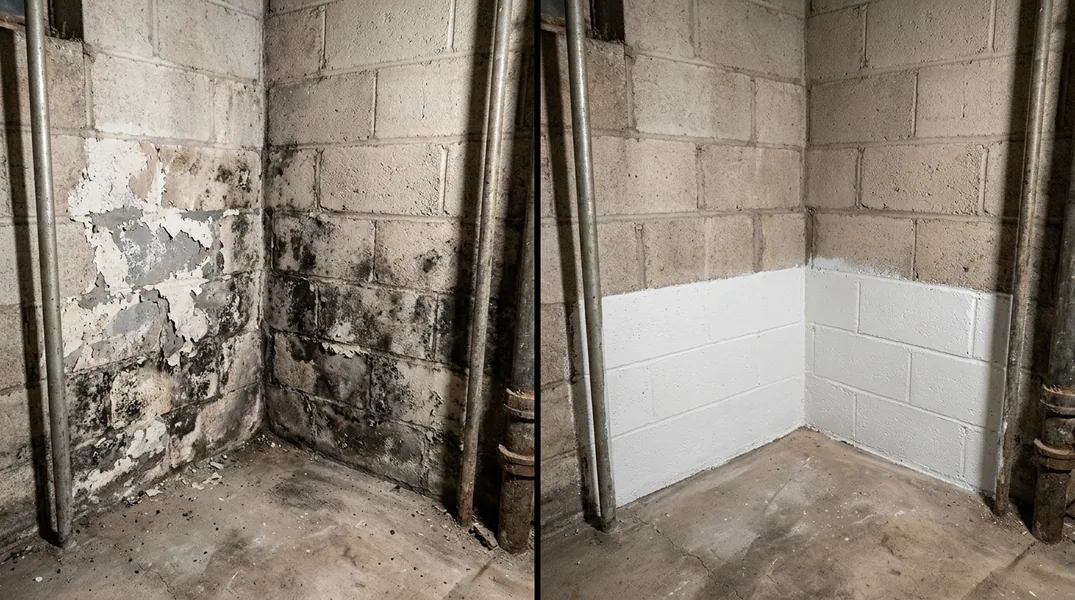
Why Iowa City Basements Face Unique Water Challenges
Homes in Iowa City sit on some of the most water-active ground in the Midwest. The region's clay-heavy soils absorb slowly and hold moisture for long periods, which means water that seeps down along your foundation walls has nowhere to go. Add in the freeze-thaw cycles of an Iowa winter and the heavy spring rains that roll through the Iowa River valley, and you have conditions that test every foundation. Many older homes near downtown Iowa City were built before modern drainage standards existed, so their footing drains may be clay tile that has long since collapsed or clogged.
Newer construction is not automatically safe either. Backfill soil around a new foundation is looser than undisturbed earth, so it can channel water straight down to the footing. Whether your home is a 1920s bungalow or a recent build in a growing subdivision, understanding how water moves around it is the first step. That is where the interior vs exterior waterproofing decision begins, and it is a decision worth making carefully because the two approaches solve different problems in different ways.
How Interior Basement Waterproofing Works
An Interior Drain Tile System is installed on the inside of your basement, along the perimeter of the floor where it meets the wall. The crew breaks out a narrow strip of concrete, digs a trench down to the footing, and lays perforated pipe surrounded by washed gravel. Water that collects under the floor or seeps through wall joints flows into that pipe and is routed to a sump pit, where a pump lifts it out and away from the house. The concrete is then patched, and often a vapor barrier or wall drainage panel is added to manage humidity.
The biggest practical advantage is that interior work happens entirely inside your home. There is no digging up of landscaping, no removing decks or sidewalks, and no risk of disturbing a mature tree's root system. It also works year-round, even in January, which matters in Iowa. Interior systems are typically the more affordable route, and they are highly effective at stopping the hydrostatic pressure that pushes water up through the floor slab, a problem exterior systems cannot address. If you want to compare numbers, our pricing page outlines typical ranges.
How Exterior Basement Waterproofing Works
Exterior Basement Waterproofing attacks the problem from the outside. The crew excavates down to the footing, repairs or replaces the drain tile, applies a waterproof membrane to the exterior wall surface, and backfills with gravel and soil graded to shed water away from the house. This approach stops water before it ever touches the foundation wall, which makes it the gold standard for keeping a basement truly dry. It is also the only way to fix a failing exterior footing drain or to address structural issues like bowing walls caused by saturated soil.
The trade-offs are real. Exterior work means excavation, which can disturb landscaping, driveways, and patios, and it usually costs more than an interior system. It also depends on weather, since open excavations do not fare well in a Iowa downpour. For homeowners in Coralville or North Liberty with newer homes and intact landscaping, the disruption can be a genuine consideration. That said, when the exterior drain tile has failed or the wall itself is under severe pressure, exterior work is often the only permanent fix. A full Foundation Waterproofing plan may combine both approaches for the best result.
Drain Tile vs Exterior Membrane: Which Does What
Homeowners often ask about drain tile vs exterior membrane as if they are competing options, but they actually do different jobs. Drain tile, whether interior or exterior, is a collection and removal system. It captures water and moves it away. An exterior membrane is a barrier: it keeps water from soaking into the concrete or block wall in the first place. A good exterior system uses both, because a membrane without drainage can trap water against the wall, and drainage without a membrane leaves the wall itself damp.
On the interior side, the equivalent pairing is drain tile plus a wall vapor barrier. For most Iowa City homes, the right answer depends on where the water is coming from. If you see water seeping at the cove joint where the floor meets the wall, or damp patches on the floor slab, interior drainage is usually the direct fix. If the walls themselves are wet, stained, or showing white efflorescence, an exterior barrier or interior wall panel system is needed. A professional inspection should trace the water source before anyone recommends a system.
Basement Waterproofing Cost in Iowa City: What to Budget
Cost is where the interior vs exterior waterproofing comparison gets concrete. Interior drain tile systems generally fall in the range of a few thousand dollars for a typical basement, depending on linear footage, sump pump configuration, and whether wall panels are added. Exterior systems cost more because of excavation, disposal, and restoration, often running significantly higher for the same footprint. Neither number is a reason to choose blindly, because the cheaper option that does not solve your actual problem is no bargain.
Budget also needs to account for the hidden costs of waiting. Foundation damage from unchecked water can run into five figures, and mold remediation adds another layer. If you are unsure which system your home needs, the smartest first step is an inspection. Iowa City Waterproofing offers a free estimate that includes a walkthrough of the problem areas and a written recommendation, so you can compare options with real numbers instead of guesses. Call (319) 205-2135 to schedule a visit.
Basement Waterproofing Near Me: When to Call a Pro
Some water issues are cosmetic, but many are early warnings. Call a professional if you notice a musty smell that will not go away, visible mold or mildew on walls or stored items, water stains or efflorescence on the foundation walls, cracks that are widening, or a sump pump that runs constantly. In Iowa, a wet basement after spring snowmelt is common, but common does not mean harmless. Repeated moisture cycles weaken mortar, rust mechanical equipment, and degrade any finished space.
A local contractor who works in Tiffin and the surrounding communities understands the specific soil and weather patterns here, which matters more than a national franchise's sales pitch. Ask how the company diagnoses water sources, whether they offer both interior and exterior solutions, and what warranties cover. The right answer is rarely one-size-fits-all. It is the system that matches your home's actual water path, installed by a team that will still be around to honor the warranty. Reach out to Iowa City Waterproofing at (319) 205-2135 to get started.
Looking for a professional basement waterproofing contractor in Iowa City? Iowa City Waterproofing responds fast for all your basement waterproofing needs.
Get a Free QuoteOur services: Basement Waterproofing · Interior Drain Tile System · Exterior Basement Waterproofing