The Two Soils Under Every Iowa City Home
If you live in Iowa City, your home sits on a geological layer cake that was deposited thousands of years ago. The top layer is loess, a fine, wind-blown silt that covers much of eastern Iowa. Below that, you will often find glacial till, a dense, unsorted mix of clay, sand, gravel, and boulders left behind by retreating ice sheets. Together, these two materials create the soil conditions that send water toward your foundation.
Loess is deceptive. It looks and feels like rich topsoil, and it drains reasonably well in dry weather. But when it becomes saturated, loess loses its structure and can slump or flow. Glacial till, on the other hand, is heavy and sticky. Its high clay content means it holds water like a sponge and releases it very slowly. When you build a house on top of these layers, you are essentially placing a basement box into a landscape that naturally wants to move water downhill and sideways.
Why Iowa City Clay Soil Puts Pressure on Foundations
Clay soil is the quiet troublemaker of Coralville and North Liberty as well, because the same glacial deposits extend across the region. Clay particles are tiny and flat, and they pack together tightly. That tight packing means water cannot pass through quickly. Instead, water accumulates in the pores and expands the clay. This expansion creates hydrostatic pressure against your foundation walls, and that pressure is one of the leading causes of Basement Waterproofing problems in Johnson County.
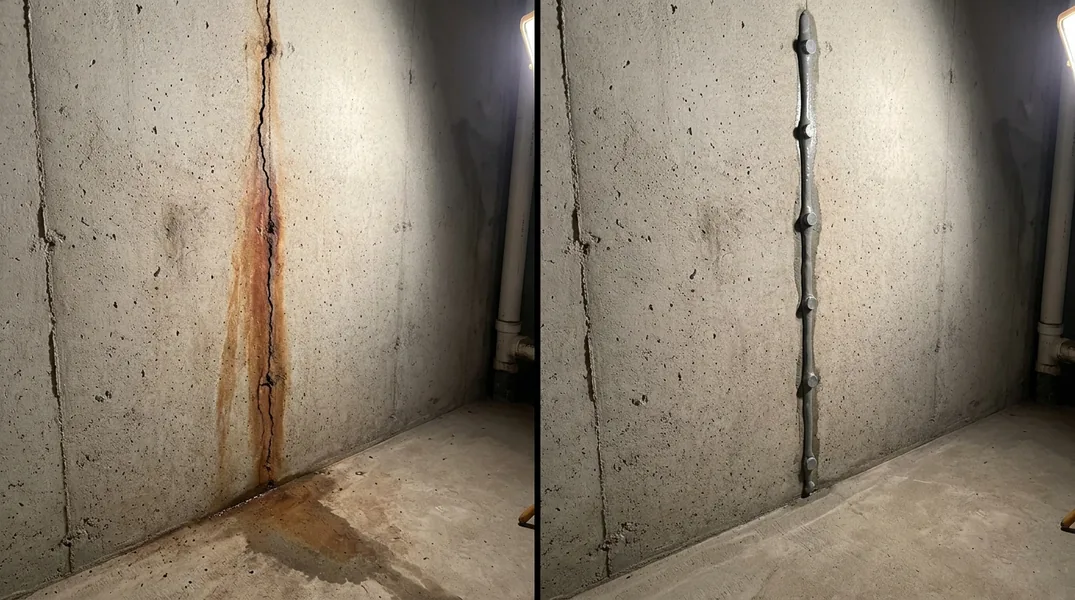
During a wet spring, the clay around your foundation swells. During a dry summer, it shrinks and cracks. This cycle of expansion and contraction is called soil movement, and it is relentless. It can open seams in poured concrete, crack block walls, and pull apart the cove joint where the floor meets the wall. Once a crack forms, water finds it. That is why so many homeowners in the area notice dampness or white powdery efflorescence on their basement walls after a heavy rain.
How Loess Soil Basement Leaks Happen
Loess soil basement leaks often start at the surface and work their way down. Because loess is fine-grained, it can be easily eroded by water running off roofs and driveways. If your gutters discharge too close to the house, or if the ground around your foundation slopes back toward the walls, water will pool in the loess layer. That saturated silt then presses against the foundation and seeps through any available opening, including window wells, tie holes, and hairline cracks.
What makes loess especially tricky is that it can look stable on the surface while being saturated below. A homeowner in Tiffin might see a dry yard but still get water in the basement because the water is traveling through the loess and till layers underground. This is why surface fixes alone rarely solve the problem. You need a system that manages water at the foundation level, not just at the gutter.
Interior Drain Tile System: Managing Water That Finds a Way In
When water has already found its way through the cove joint or through cracks in the wall, an Interior Drain Tile System is often the most practical solution. This system is installed along the inside perimeter of the basement footing. It collects water that enters through the walls or floor and channels it to a sump pump, which then discharges it away from the house. Because it is installed indoors, it is not affected by the freeze-thaw cycles that can damage exterior systems in Iowa.
An interior system also addresses the hydrostatic pressure problem directly. By relieving water pressure at the footing, it reduces the chance that water will push through the floor or wall joints. For many homes in Iowa City, this is the least disruptive and most cost-effective way to keep a basement dry. It works well in combination with crack injection and a vapor barrier, and it can be installed year-round without digging up your landscaping.
Exterior Basement Waterproofing and Foundation Waterproofing: When Outside Work Makes Sense
Sometimes the best defense is on the outside. Exterior Basement Waterproofing involves excavating around the foundation, applying a waterproof membrane to the walls, and installing drainage that directs water away from the house. This approach is often recommended when the foundation walls are damaged, when the soil around the house is consistently saturated, or when you are already planning major landscaping work. It addresses the source of the water rather than managing it after it enters.
Foundation Waterproofing is the broader category that includes both interior and exterior strategies, plus grading, downspout extensions, and crack repair. A professional assessment is the best way to determine which combination is right for your home. The goal is always to control soil movement and water pressure, not just to patch a leak. If you are unsure where to start, a free estimate can give you a clear picture of your options and pricing.
Basement Waterproofing Near Me: When to Call a Pro in Iowa City
Not every damp basement is an emergency, but some signs should prompt a call to a professional. If you see standing water after storms, notice cracks that are widening, or smell mustiness that does not go away, the soil around your foundation is likely sending more water than your home can handle. Soil movement from clay expansion can also cause doors to stick and drywall cracks to appear, which are signs that the foundation is under stress.
Iowa City Waterproofing serves homeowners across the area who are dealing with exactly these issues. A thorough inspection can identify whether you need an interior drain tile system, exterior waterproofing, or a combination of solutions. Call (319) 205-2135 to schedule a free estimate and get a plan that fits your home and your budget. You can also contact the team online to ask questions or request a visit.
Looking for a professional basement waterproofing contractor in Iowa City? Iowa City Waterproofing responds fast for all your basement waterproofing needs.
Get a Free QuoteOur services: Basement Waterproofing · Interior Drain Tile System · Exterior Basement Waterproofing